
What is the minimum stair width for a stairlift? This depends on whether a staircase is straight or curved, and any other potential obstacles. Generally you should measure the staircase width at its narrowest point, as this is the sticking point for a stairlift. This can often be at the newel post across to the skirting board.
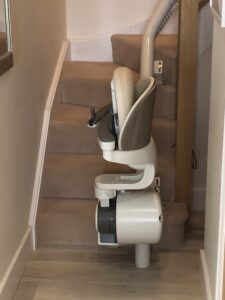
Most stairlifts have a width limit of around 66-71cm for straight stairs. Beyond that width you’ll need a specialist stairlift such as the Flow X. The Flow X can be installed on stairs as narrow as 61cm in width.
Minimum Stair Width For Stair Lift – Measurements
The staircase width is not the only consideration when it comes to stairlift installation. Other considerations are obstacles such as staircases with bends, doorways and corridors, and any obstacle which might prevent a stairlift from being installed.
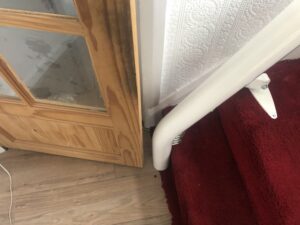
Here’s a stairlift installation where the doorway at the base of the stairs was impeding access. The stairlift used was a Flow 2a which has a clever “drop nose” rail to avoid the doorway. This is a much better solution than the often used retracting rail. A retracting rail can work here, but if there’s a breakdown, it can mean exits are blocked.
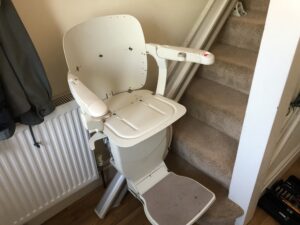
In the picture below, you can see the radiator caused a slight problem, and had to be removed. The stairlift footplate was clashing with the newel post. This was a particularly narrow staircase but the Stannah 260 was a great solution, although there wasn’t much wiggle room left once installed!
Other Potential Problems For Stairlifts
Other potential problems for a stairlift include the leg to knee measurement of the user. This measurement might prevent a stairlift from being used, or a specialist stairlift might be needed.
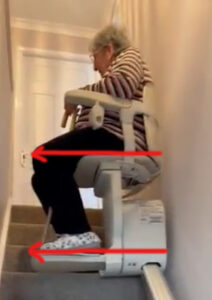
Why is this measurement so important? Well, some people have longer legs than others. So when you’re dealing with a narrow staircase, the leg length can play a significant part. Even with a specialist lift such as the Flow X, leg length can play a part with a difficult corner, for example. If someone has had recent surgery, or a knee replacement, for example, they can often struggle getting their legs back under their knees, on the footplate. This can make it more difficult for a stairlift installation on a very narrow staircase. See also best stairlifts for narrow stairs.
The Flow X is the go-to stairlift for difficult situations where a standard lift won’t fit. The seating position is facing downwards, unlike a traditional lift. This gives the user more legroom.

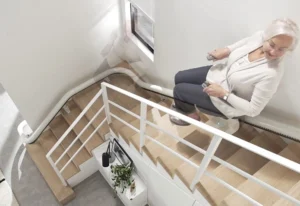
The back to knee or back to toe measurement (whichever is greater) is often the crucial measurement on very awkward stairs. This can determine whether a particular make/model of stairlift can be used.
Summary
The minimum width for a stairlift is 61cm using the specialist stairlift the Flow X. Most households won’t need such a high specification stairlift however, as most lifts can cope with 66-71cm for a straight staircase. Curved, narrow staircases are more tricky for stairlifts to navigate because of the turns and leg room needed on corners.
The staircase should be measured at the narrowest point and other obstacles should be also taken into account. The leg length (back to knee, or back to toe) should be taken, whichever is the greater distance.
Speak to our team if you have an awkward staircase as we will have a solution for even the trickiest staircases!
Call 0800 0337 133 or leave a message on our contact page here.